Table of Contents
Introduction: What are DP’s G-Units known for?
When it comes to having powerful stride units, Dimension Police is a clan that can easily contend with other clans. With skills that destroy sentinels, refresh your field, and even restand your entire six-digit center column, it is both exciting and difficult how you will be able to fit in all of these units in a cramped, 16 G-unit zone. However, while at first glance each of the vanguard-centric effects is powerful in its own right, not all strides are able to do well in the ever-changing and quite diverse clan meta. Some strides, while seemingly good for certain turns and does things that other powerful strides might not be able to do, is simply too situational to include in your G-zone, hence it does not earn the spot despite being useful in its own right. On the other hand, some strides, while highly situational, are simply too good to pass up on, and thus deserve a spot or two in your stride units. Put in another way, nearly all Dimension Police G-Units are all Ivy League contenders (so to speak) in the world of vanguard, but because there is only so much space in the “university”, not all of them will get in despite having their own unique powerful abilities. This brings up an important question: Which G-units should deserve a spot in your deck and why and when should you use them?
To understand which G-units should be put in the line-up, it is first important to know and understand the game plan a DP user has. Dimension Police, by its nature, is a power-stacking clan; it focuses on consistently generating a powerful center column that is only blockable through sentinels and attempts to “redistribute” its excess powers to its rearguards in the form of unlocking powerful effects as the vanguard accumulates more power. However, because the clan is heavily reliant on one unit to do the bulk of its damage, it runs into the problems of being slowed down by clans that can easily access sentinels. Thus, it isn’t always wise to rely on the vanguard; in case the opponent is able to consistently block your vanguard attacks, it would be wise to invest more power into your rearguards which in the right circumstances, can hit nearly as hard as your vanguard. Cards such as Platinum Ace and Silbard are excellent examples of this, as both these units are able to gain extra power and a critical if your vanguard is above a certain power threshold. Combine this with rearguard-centered stride units such as Daimax (Both the OG and the DX version), and you can easily build columns that can threaten your opponent’s vanguard as well as your vanguard does.
In addition to choosing which stride units to choose, you also run into the problem of deciding which and how many G-guardians you should put in your line-up. Due to Dimension Police’s ability to draw many cards and have extra drive checks, it is more than likely that you would have one or two heals in your hand in matches. Thus, you have more freedom in deciding whether to use a G-guardian that flips its peers in the G-zone or regular ones that can protect you better in the long term. For example, Atlantis Dolphin is a unit that flips another G-guardian face up and allows you to potentially guard for 40k with that card alone while giving you a countercharge and a soul charge. However, Great Galactic Beast, Zeal is another good unit because it gives you a +5k for the rest of your opponent’s turn, which is useful against Protect or Accel clans but can cost you a counterblast and a soul blast. However, deciding how many to run of these cards is difficult as you have to decide how you will manage these resources. Use too many flip guardians, and you might not have enough defenses for later turns. On the other hand, using too many of the single G-guards might lock you out of the flip guardians, which is more useful for units such as Bravest Peak, Gallop to reach even higher power thresholds. Thus, in anticipation of having at least two heals in a match, I would personally recommend running five G-guardians in your deck. Too many, and you may compromise the overall adaptability of your deck by limiting the possible options for striding depending on the situation.
In other words, what you should keep in mind when building your G-zone is to prioritize powerful vanguard-centered stride units first, have stride units that can bolster your rearguards to ridiculous levels, and throw in some G-guardians that can help you survive your opponent’s turn without sacrificing too many resources to do so.
Criteria: How do I decide which units to run?
Personally speaking, I run 11 stride units and 5 G-guardians in my Dimension Police deck. It was quite difficult deciding which ones to run and I do admit budget was one of the limiting factors that contributed to this line-up. However, as I was deciding which units should I run, I came up with a sort of simple criteria for judging how important this unit is and how it may benefit me in a variety of games. These criteria, admittedly, are quite subjective, and choosing which G-units to actually run may be up to your imagined playstyle. This is not to say, however, that the process for deciding which G-units is subjective; there are some G-units that are just simply too good to not run, and some G-units are just so specific and costly that I wouldn’t recommend running any copies of them at all. As such, I have skipped over the G-units that are simply not good enough to even consider running in this review and opted to focus specifically on giving detailed explanations on the units that are actually worth considering or running. I also decided to exclude Metalborgs from the stride list, as the abysmal amount of support they received over the years ensured that they only function as a very niche deck. You’d have to build a Metalborg specific deck for you to actually use the stride units, and only a few people play this deck. Sorry Metalborg users, I might have to make it up to you all next time.
Here are some of the criteria that I had in mind as I was building my deck:
Versatility – This refers to how well a G-unit is able to adapt to a variety of situations and play styles that it may encounter. Some G-units are able to mitigate the clan’s shortcomings thanks to its powerful effects, which allows it to either serve as the first or second stride or perhaps a unit that you can safely use if you have no clear idea of what situation you are in right now. A versatile unit is able to function well regardless of what clan or build it fights and allows you to have more options in your succeeding turns.
Situational Value – In contrast to the versatility, units with high situational value are optimal choices for certain situations that a versatile unit would otherwise be too unfocused to fully capitalize on. Situational units are great because they can potentially secure games for you by activating effects that aren’t normally used by other units (Daimax’s rearguard oriented effect or Daiking’s full-field boost).
Costliness – Dimension Police are quite counterblast heavy and thus needs to be able to plan their resources well, so it does get damage locked by opponents. Thus, I also factored in how costly a unit’s effects is and how worth it the payoff is. Some G-units have powerful effects but are otherwise held back by their possible cost.
Price Tag – Building a Dimension Police deck can be really expensive if you want to go all-in, so I decided to also include the possible costs you might need to know before you decide whether to run a specific unit. Some units are just too expensive to run and may have more affordable alternative options that might be less powerful, but still gets the job done.
With no further ado, here are some of the contenders for your G-zone line-up and why they may be worth running or not.
Stride Units: The spearheads of the offensive
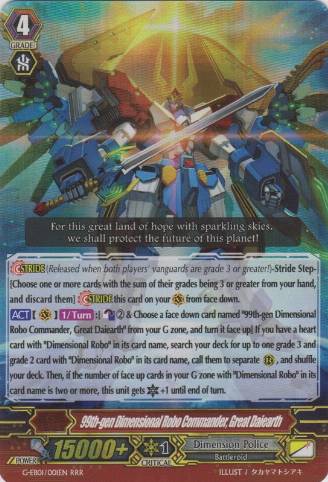
99th-gen Dimensional Robo Commander, Great Daiearth – Starting the list is the unit with a mouthful of a name, Great Daiearth. In terms of versatility, Great Daiearth can fall short unless you are running a Dimensional Robo-specific build. However, when you do manage to build one to proc his skill, he can be quite powerful, as he is able to fetch specific units in your deck such as Kaizard V for grade 2 and a Daikaiser V for grade 3. If you manage to get the extra critical, you are looking at a unit that your opponent would definitely want to guard, lest they get hit by a three-critical attack. However, because Geomaglass exists, who does the job with less consistency but with both more short and long-term benefits, it is actually quite difficult to justify running this card in the first place. The CB2 cost is too heavy especially when you have other units and turns to keep in mind and using this card’s effects leaves you wide open for a damage choke from your opponent. The real-life cost is just bad too since a copy of this unit can set you back 10 USD with little payoffs in using it. The +2 pales in comparison to the possible drawbacks you might get from this card, and that is why I would recommend not running this card at all. As much as it hurts to say, Geomaglass is simply the “cooler Daiearth” in this case.
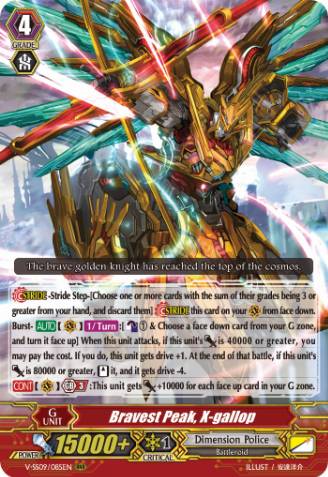
Bravest Peak, X-gallop – X-gallop’s overall strength, versatility, low cost, and requirements that are too easy to proc earns him a guaranteed spot in my G-Zone lineup. This card is just ridiculous; for the price of one CB and a flipped G-unit, you get a restanding quad drive vanguard that can easily hit 60k+ thanks to his GB3 effect. Combine this with cards that give additional criticals such as Laurel and Daijacker, and you have a unit that can singlehandedly threaten your opponent as a true Dimension Police unit should. It’s so strong that some DP players have considered it the only G-unit you need, just because it’s a massive re-standing beat stick that does not require any discards at all. The only downside is that it costs around 13 USD a piece, but that’s quite fair when you consider the fact that it becomes possible to have a budget Dimension Police deck because of this guy. For this reason, I would recommend running at least 2 copies of this guy, as his flip requirement doesn’t need to be the same copy as him; you can flip a Geomaglass and you would get both offensive and defensive abilities without many costs at all.
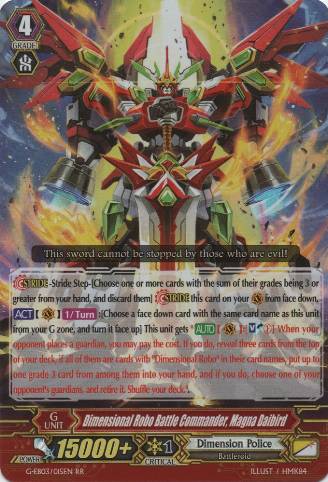
Dimensional Robo Battle Commander, Magna Daibird – Ah yes, the card that can singlehandedly give you five cards while destroying each of your opponent’s guardians, in the right circumstances. Daibird is a stride unit that has a low cost; you flip a copy of it in your G-zone, and you basically gain the ability to rip through your opponent’s guardians while filtering your deck for triggers. However, it is important to note that this card DOES NOT stop sentinels; it can retire a perfect guard, but the effect of “cannot be hit until end of battle” remains (see Daikaiser Leon’s effect to know the specifics). Thus, the card is quite situational as far as offensive value goes. Furthermore, this card only works in a Dimensional Robo deck, which is quite expensive to build. However, the card is ridiculously cheap, as it is only 25 cents a copy. For the Dimensional Robo users out there, I would say running 2 copies at most is good enough and should be used once you know your opponent has spent all of their sentinels the previous turns before using it.
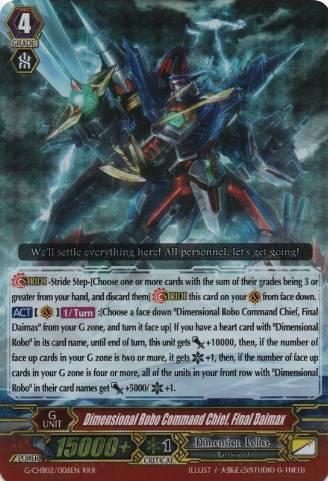
Dimensional Robo Command Chief, Final Daimax – While being inherently Dimensional Robo restricted, this card is just bonkers; it can hit for up to three criticals and 43k alone, provided you have enough face-up D-Robos in your G-Zone. In addition to this, his effect also gives your rearguards a +5k and a critical, which is outright deadly if your opponent is sitting at four damage. Daimax is a powerful card that you should use when you know your opponent has enough resources to stop your vanguard easily; Thanks to his front-row bolstering effect, it becomes possible to shred your opponent’s hands if you are not confident that a vanguard attack alone is unable to finish them on your current turn. It’s also virtually costless, as it only requires you to flip a copy of him face-up in your G-Zone. Unfortunately, I cannot say the same for his actual cost, as he costs a whopping 19 USD on average per copy. Personally, if I had this card, I would run two copies of him just because it’s useful for when my opponent is stockpiling their sentinels and I have some Platinum Aces in my hand. For now, though, I am using the budget version, which is Daimax DX.
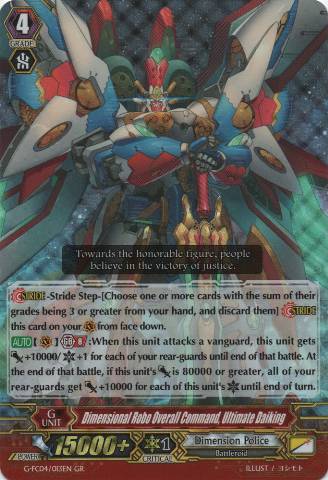
Dimensional Robo Overall Command, Ultimate Daiking – Dimension Police’s GB8 unit is the definition of overkill; he can literally hit for six criticals on a full field and can reach six-digit numbers alone. In addition, he gives ALL your rearguards a +10k for each of his criticals i.e., +60k on a full field. Because of these comically huge numbers, I tend to use it for when my opponent is sitting at 4 or 5 damage, and I know that they will need to start guarding my rearguards if they want to survive. Otherwise, this card is just very situational as it is locked behind GB8, and you usually use another stride unit to finish the game if it goes on for too long. However, he only costs 4 USD and is virtually costless to use otherwise. For this reason, I only run one copy of him, as flip fodder for when I know I can end the game early then I can use his skill or for when I just want to turn juice up my rearguards to vanguard levels.
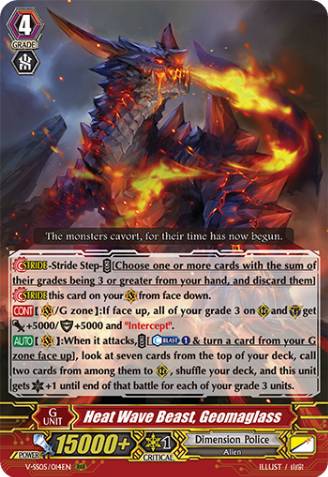
Heat Wave Beast, Geomaglass – You run this at three copies, four if you want to mess with your opponent. No seriously, this card is just really good. You superior call two grade 3 units when he attacks, potentially hit for three criticals, and all your grade 3 units become juicy beat sticks and intercepting guardians and gets stronger the more face-up copies you have of it on the G-Zone. Want a strong first stride? You use Geomaglass. Need a reliable flip fodder that isn’t stuck as decoration? You flip Geomaglass. This card is just really good and versatile and arguably what fixed DP’s long-time problem of having no good first stride units. It would not be a stretch to say that you are not maximizing DP’s potential if you do not have even a single copy of this card. Because it only costs one CB and does not require you to flip a copy of it for when you pay its cost, this card will work everywhere. The 9 USD price tag is justifiable for the amount of stuff you can do with this card. Definitely run this card or you’re missing out on so much.
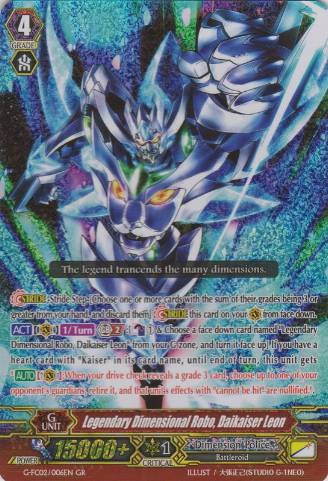
Legendary Dimensional Robo, Daikaiser Leon – For a Dimensional Robo build, this card is bonkers and straightforward as it can get. If you are GB2, you CB1 and flip a copy of him and your vanguard gains the amazing power of nuking guardians, sentinels included, to oblivion every time you reveal a grade 3, provided you have Daikaiser as the heart unit. With the introduction of the V series Daikaiser, this can be deadly to your opponent, as a single grade 3 would mean your attack breaking through a perfect guard and your opponent taking an additional damage thanks to Daikaiser V, to add salt to their deep wounds that will stay with them for the rest of their cardfighting career. It’s definitely used to either secure games or to win back from the brink if you have no other options, as your opponent would have to either throw in two sentinels or guard normally to stop this behemoth of an attack, and even then a DP deck can recycle Grade 3s reliably, which means that there is always a chance that you will destroy them regardless. Sadly, Daikaiser Leon is quite expensive, setting you back 15 USD apiece and will only go higher as the new Daikaiser support gets released. If I had him, I would definitely run him at two copies at most. Any more, and the deck would be too reliant on proccing guard breaks to function well across a variety of situations.
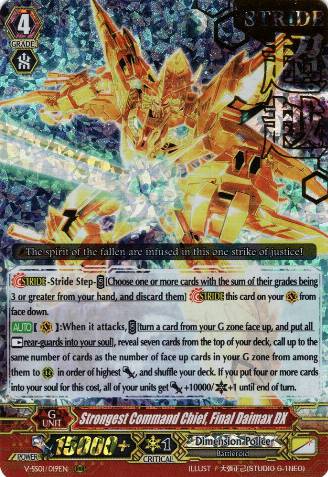
Strongest Command Chief, Final Daimax DX – I see this guy as the budget version of his younger self because it only costs you below 1 USD to get a copy of this guy. However, this guy is quite possibly DP’s only option for multi-attacking, as he basically refreshes your field by putting all your rested rearguards to the soul and calling one unit from the top seven cards of your deck for each face-up card you have in your G-zone. If you put in four or more rearguards, you basically give your entire front row a +10k and a critical. This card is really good for when you want to filter the cards in your deck too, as you can easily call grade 1-3 units from the top seven and check any remaining triggers once you perform your drive checks. The flip cost is also not restricted too, so you can flip a copy of Geomaglass for his cost and you gain more power and shields. Personally, I run two copies of this guy for when I need either multiple attacks or units to my field. However, one would probably suffice as you do not want to use this guy’s effect too much or risk decking out.
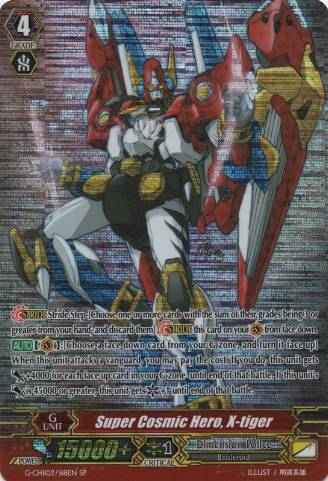
Super Cosmic Hero, X-tiger – Honestly speaking, this guy was my go-to stride unit for the first turn before Geomaglass showed up. X-tiger is essentially costless, only requiring you to flip a G-unit for his cost and potentially hit for 2 criticals if his power is 45k or greater. Because of the way DP stacks power, it is quite easy to get him to 45k on your first turn. Sadly, X-tiger finally loses his spot on the roster because of better stride options and how one-off his skill is. Geomaglass does his job way better, and he costs 2.50 USD apiece. For this reason, I don’t run him anymore except as flip fodder while I still don’t have the better stride units.
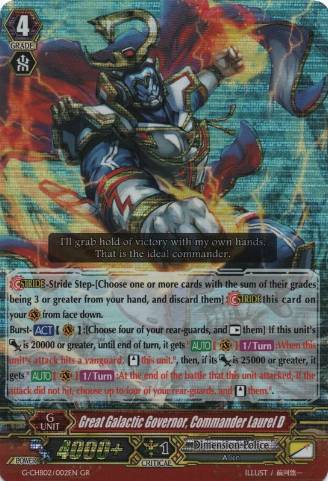
Great Galactic Governor, Commander Laurel D – This unit is essentially a living relic of what vanguard was before the massive power creep set in. Laurel D is a peculiar stride unit because he is only a 4k-base G-unit with an on-hit restand effect if his power is 20k or more before the battle phase. This was only of the first strides DP used to rely on in the early days because of a re-stand that has no minus at all, and even refunds the cost of resting your rearguards if his attack does not hit, provided he is at 25k or greater power before the battle phase. Unfortunately, hitting that low on your first stride is just pitiful and may even insult your opponent for daring to stride such a unit, so I do not run any copies of this guy anymore. He has cool art though, and I am lowkey hoping that his name is foreshadowing for Dimension Police encounter cards in Overdress.
G-Guardians: The shielders n’ lifesavers
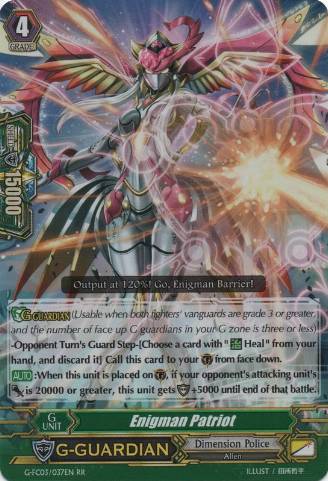
Enigman Patriot – This is DP’s generic G-guardian and is basically costless. It gains +5k shield for when your opponent’s attacking unit’s power is 20k greater, which is basically always. Seriously Bushiroad, who would waste a G-guardian on a unit with less than 20k power? It only costs around 25 cents per copy, so this is a great budget option that I would run at two copies if I do not have other options. Otherwise, this card is just eh.
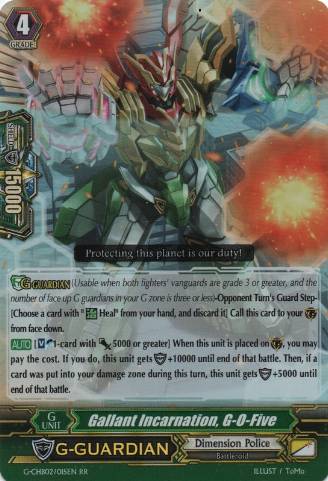
Gallant Incarnation, G-O-Five – Five is basically a 25k shield G-guardian whose cost is easily payable with a soul-blast. If you took damage that turn, it becomes a 30k shield. This makes this unit a very versatile and “costless” option for a strong G-guardian. However, it would set you back around 3 USD per piece of this card, which is quite fair for the effect that it does. I run this in place of Enigman Patriot, just because DP doesn’t care about soul blasting as a cost because of how powerful their soul charges can be.
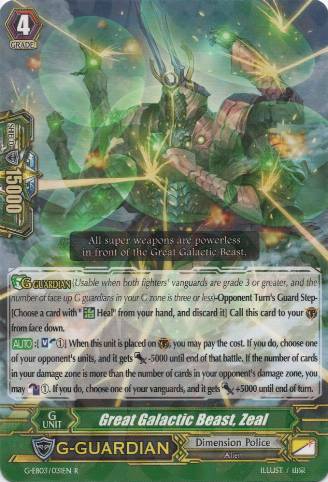
Great Galactic Beast, Zeal – Zeal is an awesome unit for bolstering your vanguard’s defense during your opponent’s turn. Under the right conditions, Zeal is able to guard for 25k shield. His second skill, which costs a CB, gives your vanguard a +5k until the end of your opponent’s turn, which is very useful against poking numbers and for avoiding magic numbers that a single card otherwise would not be able to stop. However, do keep in mind that this requires you to have more damage than your opponent to activate. Because it only costs 87 cents, it is definitely affordable and makes a good addition to your G-zone. For this reason, I run him at two copies, which can turn my vanguard into a 23k unit on my opponent’s turn.
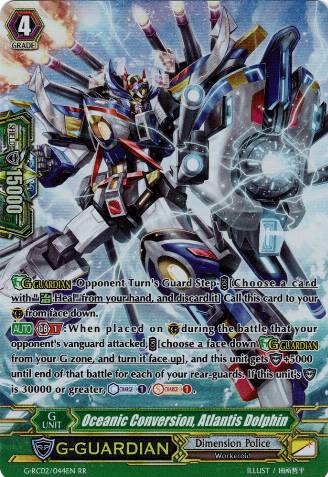
Oceanic Conversion, Atlantis Dolphin – Atlantis Dolphin is DP’s “Flip Guardian”. It gains +5k shield for each of your RGs and it allows you to refresh your CBs and SBs if you have enough RGs. This makes it an excellent option for conserving your CBs while guarding your opponent, and it contributes to fixing DP’s CB-heavy nature. At 50 cents apiece, I run two copies of this guy and it honestly saved me some games by allowing me to refresh my resources for a kill turn later on.
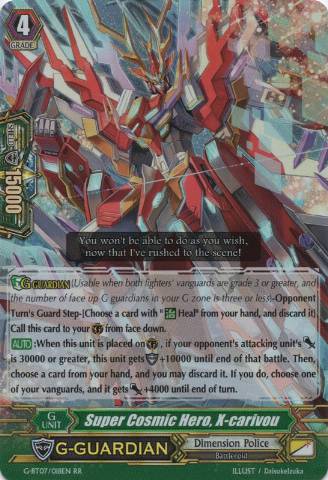
Super Cosmic Hero, X-Carivou- Another 25k shield option, X-carivou is a costless guardian that fills the same role as G-O-Five. The only difference, however, is that he gives you a +4k until the end of your opponent’s turn provided you discard a card for his cost. While seemingly better than Zeal because of a skill that’s easier to proc, the -1 from your discard is generally not worth it, as a +4k does not hit magic numbers on its own against all kinds of deck. Furthermore, the -1 could be used to stop another crucial attack. Thus, I do not run this card anymore because of its “heavy" cost.
Final Thoughts: So what do I do now?
When building your G-zone for your precious Dimension Police deck, I highly recommend always imagining the worst-case scenario happening and imagining how you might build for it. Think your opponent will have no problems stopping your vanguard attack alone? Throw in a Daimax or two and force them to respect your rearguards during your turn. Worried that your opponent might have too many sentinels in hand and need to force them out? Call in Daikaiser and force them to waste precious resources trying to guard your attack. All in all, vanguard is a game with unpredictability as an inherent factor, so it’s always better to value consistency over versatility. At the end of the day though, how you play determines which deck you should use, so it’s always better to experiment on your builds and see how consistently you can win with your deck. If not, then perhaps you should work on yourself too and decide how you can use counterplays to win unfavorable matchups.
That being said, I hope you enjoyed reading my article and I wish you the happiest and thrilling of cardfights!